LocalDelicious.com is all about eating local and finding delicious, locally produced products so you have more options for eating local. Embedded in that is my belief that supporting local farmers and food producers builds our economy and builds our community — not necessarily in that order and with equal importance. (It’s hard to have a strong community with a weak economy.)
It’s sometimes hard to distinguish which issues are strictly local, though. I mean, The Environment is a heck of a huge issue, and global in scope. But it does have local ramifications, obviously.
So it is with the issue of water.
I got raked over the coals recently for having a case of bottled water in my trunk. Now here’s the confession: I’m just a regular Joan/Joe like most you. Though I’m issues-conscious and try to be generally well-informed, I am decidedly not a strict adherent to any movement. I don’t always do everything I “should” be doing to reduce my emissions (sounds a little crude, doesn’t it?), reduce my footprint, recycle/reuse, and always chose the environmentally sustainable option. Heck, I don’t even always eat local.
So there you have it: I’m a bit of a skeptic about jumping on any band wagons, but I do believe in individual responsibility and making an effort.
So when I got taken to task by a decidedly non-environmentally concerned citizen, I knew he had a point. In truth, I’ve often felt guilty about all those plastic bottles even though I frequently use them more than once and always leave them beside the dumpster so they are sure to be picked up and taken to the recycling depot. It was especially guilt-inducing when I’d have 3 or 4 empties rolling around together on the floor of the car, taunting me.
I’d often thought about alternatives to keeping bottled water in the trunk, so the pointed barb hit it’s mark. I mean, bottled water isn’t anything more than tap water and it’s often filled with more harmful junk than our local tap water is. So, what was the issue? Laziness? Inertia? The need for yet more planning ahead in an already chaotic daily schedule?
Well, I’m happy to report that the case of bottled water is now gone from my trunk, replaced with 3 non-BPA containers that I rotate. One is with me up front, two are in the trunk in case I run out. The bottled water was always about convenience, but I’ve discovered that the new system is pretty darn convenient and less hassle than I’d imagined. With the three on rotation, I’ve yet to run out.
Hah! One giant step for me, one small step for the earth.

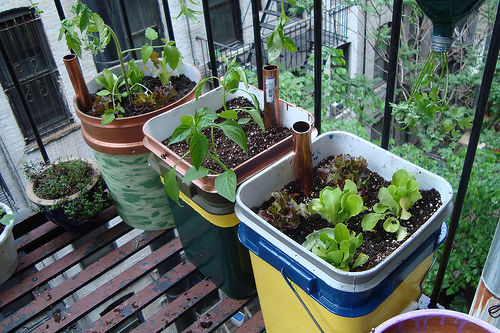 I met an urban gardener from New York City via Twitter not long ago, an avid balcony (and fire escape and yard) gardener and blogger. I checked out CanarsieBK’s blog and found some great info, including but not limited to these wicked self-watering containers.
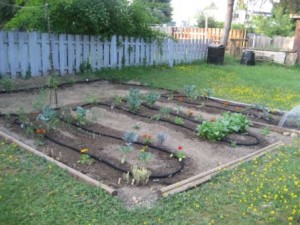 (I now actually hope for the occasional rainy, summer day. This is VERY odd.)
 Perhaps the ultimate in consuming local food and beverages, tap water is beginning a return to vogue. With the realization that bottled water leaves behind, well, bottles (3 million in Vancouver area landfills last year alone), many environmental groups and, indeed,