by Sharon Hanna
Reprinted with permission
Selecting Seeds
 Are you going to grow garlic you buy at 1.99/lb from the store? Don’t. You shouldn’t be eating that stuff — one taste of homegrown garlic, or fresh organically grown will convince you. After all, you don’t know where that garlic’s been, or worse, whose nightsoil it’s been grown in.
I recommend you begin with organically-grown garlic from BC. This is easily found at farmer’s markets all over, and at gourmet-type stores that stock organic produce. Select bulbs with large cloves—a larger sized clove will grow a bigger plant, which ideally will yield a larger bulb. Just like tulip bulbs: the little bitty ones don’t make a big flower. It’s the same with garlic.
What’s a clove, you ask? Not the tiny brown thing your mother or grandmother stuck into the ham before she bathed it in 7-Up. It’s the smaller bit that a ‘head’ of garlic gets taken apart into. By the way, do not peel the clove—it’s a little bulb, actually. Just like a tulip or daffodil bulb, it needs that hard papery coating to protect it from what’s going on underneath the soil: critters, dampness, various soil-borne effects.
Figure out where you’re going to plant your garlic at this time, paying attention to where the sun is. You’re going to be planting in the month of October. Use the 15th as a rough guideline, as earlier the soil is usually more pleasant to work with than later on when the rains start.
You’ll need about 6” between each plant. The closer you plant the cloves, the smaller your head of garlic will be. The garlic needs to take in nourishment for nine months from that soil, so give it some space. And, yes…I realize “full sun” in winter is hardly applicable in Vancouver, but do pick the sunniest spot you have on the south or west side.
The Right Soil
Garlic REALLY likes well-drained soil. If the area is boggy, don’t plant garlic in it. If there is moss or frogbit (little fungal-looking growths like on top of plant pots in the nursery sometimes) don’t plant garlic there. Sandy or loamy soil is great.
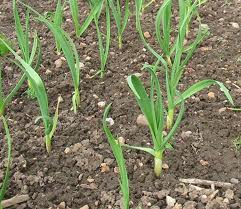 Amend (meaning, add to) the soil with a modest amount of manure, compost, Sea Soil (a great product) or whatever. Don’t worry too much—you’re not making pavlova. It will make you feel good to see the new black/rich stuff going onto the spot. Or, not. In any case, make a narrow trench using your hands or a dull instrument (don’t hurt the worms please) about 4” deep in the soil. NO need to double-dig or disturb the intricate, lasagna layers of fantastic growing medium that worms and other critters have been spending their lifetime to create.
There’s no need to plant the garlic in a straight line if you prefer the ‘drift’ look, or circles. If you do that, allow at least 8” between cloves. It’s important that garlic ‘greens’ or leaves have sun on them and the more sun they can get, the bigger and healthier your garlic will be. If they’re too packed together, your garlic will be smaller—even tiny.
Optional: sprinkle a handful of 4-10-10 fertilizer (sold at any reputable garden centre) or any other kind of good organically-based granular plant food—preferably with a larger middle number than the first number —(the NPK thing)….per foot of row, and tickle it into the soil at the bottom of your narrow trench. (If you absolutely know your soil is rich and wonderful, you don’t need to add anything.) You might like to make a small row with fertilizer, another without, and compare your results. You’re now a Garlic Scientist.
Planting
OK. Now, it’s time to plant. Disassemble your garlic heads into cloves, leaving the skin on. If you find it very difficult, it’s fine to give the head a bit of a whack on a hard surface – but not too hard so that you bruise the garlic. Put the cloves in a bowl, or in your pocket, treating them gently. Don’t peel, I say again. If you’re doing this with kids, it’s very hard for them to resist peeling it – you’ll have to explain why it’s best not to. Tell them it’s like taking off their snowsuit or coat when it’s freezing out…it protects the garlic.
Place the clove, pointy side up (yes – people plant them upside down, sadly, and it’s hard for the poor garlic to grow around in a circle, which it eventually and painstakingly does)…root side down. Poke it in a bit. Now, poke in the next clove at the suggested distance. If you’re the organized type and you’re planting a few rows, make the rows at least 1 foot, preferably 18 inches apart. (Again, think about each plant getting maximum light.) Cover with at least 3 inches of soil.
NB: it’s handy to know that most seeds need to be covered with three times their own size of soil. If a bean seed is almost ¾”at its widest, it needs around 2” of soil on top. Tiny seeds need way less. Garlic, depending on the size of the clove, needs about 3”, give or take. It is very important that you now pat down the soil lovingly.
Watering
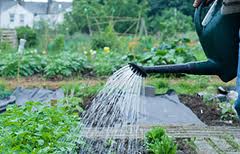 Next step: watering. Unless rain is predicted, water your garlic lightly, using a gentle mist from a hose, or a watering can with a ‘rose’ (the thing with little holes that screws on the end of the spout). Don’t water with a vengeance or strong stream.
Important: put a label or stick in next to your future garlic, indicating what you have done. This is advised if you are over 35, really important if you are over 50, and urgent if you have a tidy mate/partner who likes to dig everything up a few times a year, no matter what. Be sure to tell everyone who lives in the house that you’ve planted garlic there. If you like, stick rose prunings or other thorny, nasty branches all around the area. This will keep cats and other critters from digging, and will remind you what you’ve got in there. (This is also a great idea for early spring sowing of things in bare ground which cats love). Rose-pruning in spring usually coincides with planting, so it all works. Alternately, cover the area with upside down black plastic ‘flats’ that nursery pots come in – they work well to keep critters out, and allow rain to get in. Weigh down with rocks if you have skunks, raccoons, or squirrels and you’ve seen them digging in the area.
Now, nothing happens, between October 31st and February 14th. The sun in these parts does not burn brightly enough because of its low-angled relationship to the earth for photosynthesis, and plant growth, to occur. Lo and behold, mid-February through mid-March (depending on our spring), you notice thick grass-like bits issuing forth in the spots you planted the garlic. This is known as “emergence”. It’s a great idea now to make something with a lot of garlic and celebrate. As if we need another reason to drink fabulous red wine and dine on lovely pasta puttanesca, or other garlic-laden treats.
Your garlic is now going to start picking up speed. If you want, give it some food (kelp, fish fertilizer), not too much. Once a month is fine; if the weather gets very hot and dry in May as it sometimes does, make sure you keep the garlic bed moist, but not overly wet. Don’t bother to feed the garlic past mid-June.
Scapes
At some point in July, your garlic plants will be nearing 2.5 to 3 feet tall, and a ‘scape’ – a French-horn or gooseneck-shaped rounded stalk will emanate from the centre of each plant, and begin to twine and twirl. This appendage, if allowed to remain on the plant, will eventually form a flower, and then seeds.
 While the scape is still twirling and tender, I recommend you cut it off, and enjoy in a torrid pesto. Whirl it with lime juice, freshly grated good parmigiano, and olive oil. Savour it on bruschetta, pasta, or on slabs of toasted bread, topped with roasted anything. It is delicious and will give you foul garlic breath!
Scape-removal is controversial. (And, where does the term “scapegoat” come from, anyway?) Some garlic growers swear by removing them, others don’t. Once again, the scientist in you may want to leave a few scapes on, then compare bulb size. The rationale for removing them is that the energy will go into forming the bulb, rather than the seed-head.
You’ll start to notice some of the lily-like leaves of the garlic turning yellowish by mid to late July. This is a natural process. Rather than water the garlic, thinking there is something wrong with it, don’t. This is the time to withhold water. Towards the end of July, stop watering your garlic completely.
Please keep in mind that these events may be out by a week or two. Observe your garlic, and when the third strappy leaf has turned yellow, it’s getting close to harvest time. This year, my garlic was a week or two later than “normal” because of our freakishly cool spring and summer.
In any case, it’s ok to wait until the fourth leaf is getting yellow too, but don’t wait too long. The leaves correspond to layers of wrapping on the garlic bulb and if left too long in the ground, the garlic will start to open up and split out of its casing. The more compact and solid the bulbs are, the longer they’ll keep well.
Harvesting
Harvest time: with a patient hand, gently loosen the soil around the area using a garden fork, or shovel. Do this carefully. Pulling is not recommended; this often breaks the bulb from the stem, and your garlic could be lost. Using your hands, lift out the bulbs and marvel at how nature works. Your little cloves have turned into shiny, redolent heads of garlic.
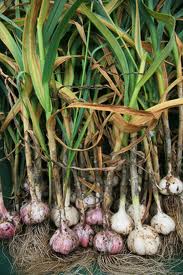 Don’t wash the bulbs—just knock a bit of the soil off. It will brush off easily later on.
If the weather is nice and warm at this time of year (sometimes it isn’t), you can leave the garlic right ‘on the field’, as they do in Gilroy, California, garlic-growing capital of the US, or perhaps even the world as we know it.
If it’s more typical Vancouver weather (sunny, rainy, cloudy, humid and/or hailing), place your garlic in a dry place and let it ‘cure’. That is, let it sit and dry out rather slowly. If you have grown a softneck variety of garlic (there are two kinds: softneck and hardneck and most are hardneck grown in these parts) you will now be able to braid your garlic. If it’s hard, you can’t do this.
I sometimes use a wooden clothes-drying rack for this stage, and leave it on the semi-sunny back porch. In about two weeks or so, depending on humidity, you can cut the leaves off, leaving about 1” of stem. Trim the roots too, leaving about ½” on the bulbs.
Abracadabra. Only nine months and you’ve become a garlic growing expert. Store your garlic in a cool, dry place. Darkness is good too. Don’t put garlic in the fridge, ever. If you store it well, it should last until next year’s garlic harvest, and so on.
================
Freelance writer and seed specialist Sharon Hanna writes regularly for GardenWise and Gardening Life. Current venture: HotBeds, urban food gardening consultation, installation and assistance.